100 Days of AI Agents.
An intensive technical journey building 500+ AI agents, focused on multi-agent orchestration, contextual memory, automation workflows, and real-world utility frameworks.
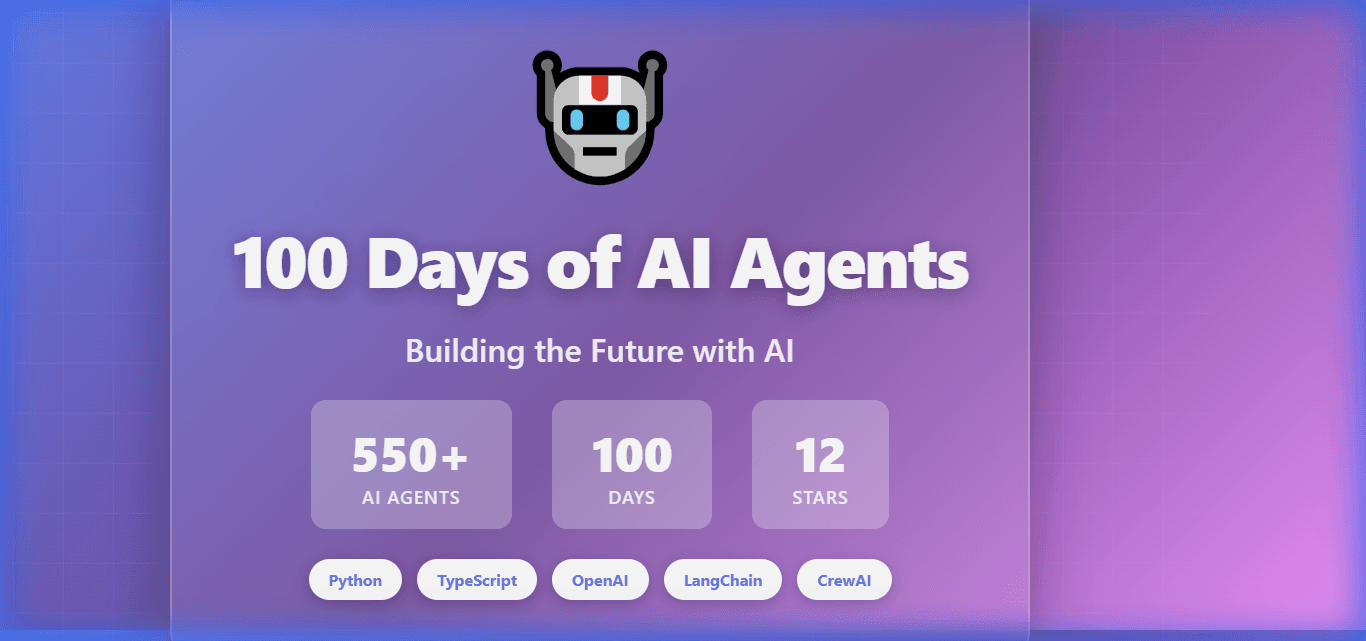
500+
Agents Built
12+
Frameworks Used
7+
E-Commerce Platforms
50+
Projects Deployed
The Challenge
The AI landscape was rapidly evolving with the emergence of Large Language Models, but there was a critical gap between simple prompt engineering and production-ready autonomous systems. The challenge was to bridge this gap by:
- •Building agents that could reason, plan, and execute complex multi-step tasks autonomously
- •Implementing contextual memory systems that persist across sessions
- •Orchestrating multiple specialized agents to collaborate on industrial-scale problems
- •Ensuring reliability, error handling, and graceful degradation in production environments
The Architecture
Core Technology Stack
Intelligence Layer
- • OpenAI GPT-4 & GPT-3.5 Turbo
- • Anthropic Claude for reasoning tasks
- • LangChain for orchestration
- • CrewAI for multi-agent coordination
Infrastructure
- • Python 3.11+ runtime
- • Vector databases (Chroma, Pinecone)
- • FastAPI for API endpoints
- • Docker containerization
Key Architectural Decisions
1. Modular Agent Design
Each agent was designed as an independent, reusable module with clearly defined inputs, outputs, and responsibilities. This enabled rapid composition and testing of complex workflows.
2. RAG-First Approach
Implemented Retrieval-Augmented Generation for all knowledge-intensive tasks, ensuring agents had access to up-to-date, domain-specific information without retraining.
3. Tool-Calling Framework
Leveraged OpenAI's function calling and custom tool integration to give agents the ability to interact with external APIs, databases, and services autonomously.
The Results
Impact & Achievements
7+
E-commerce platforms shipped with modern product workflows
50+
Deployed projects across AI, automation, commerce, and full-stack platforms
Key Learnings
- →Prompt Engineering is Critical: 80% of agent reliability comes from well-structured prompts and clear instruction hierarchies.
- →Error Handling Matters: Production agents need robust fallback mechanisms and graceful degradation strategies.
- →Context Management: Effective memory systems and context pruning are essential for long-running agent sessions.
- →Multi-Agent Coordination: CrewAI's role-based architecture proved superior to monolithic agent designs for complex tasks.
Technologies Used
Explore the complete repository
View on GitHub →